.png&w=3840&q=75)
Where you live can influence how hard your vehicle’s brakes work.
Pep Boys analyzed first-party service data from across the country to identify the U.S. metro areas with the highest rates of brake-related service. The results reveal an interesting mix of large cities, regional hubs and smaller metros, and offer drivers a new way to think about brake maintenance.
The data ranks Columbus, Ohio as the number 1 hardest-braking city in America, followed by Seattle, Indianapolis, Albany and Colorado Springs.
Whether your city made the list or not, the findings highlight an important point: your everyday driving environment can have a significant impact on your vehicle’s brakes.
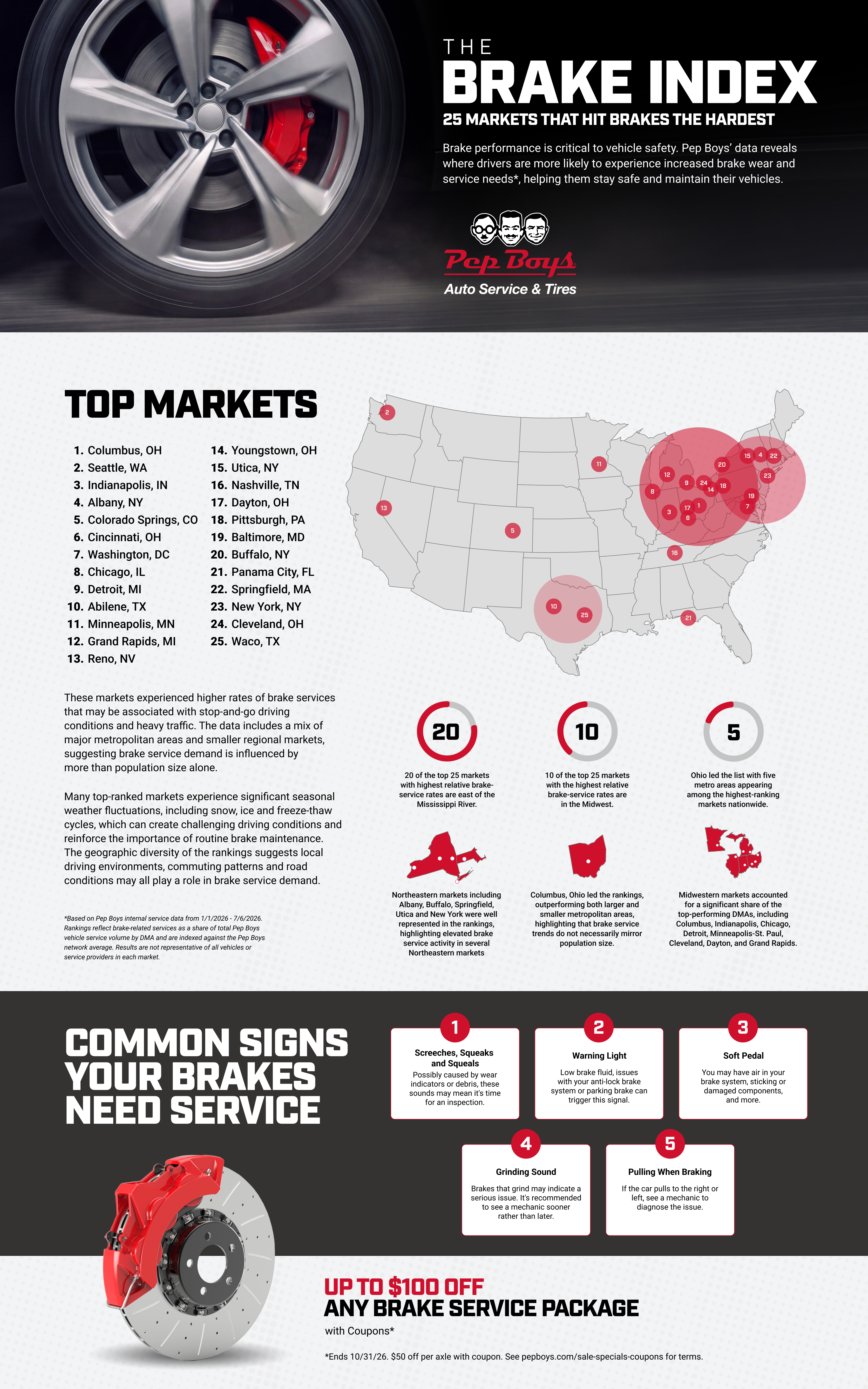
Top 25 Hardest-Braking Cities
Based on Pep Boys’ first-party service data, these are the 25 U.S. metro areas with the highest rates of brake-related service.
- Columbus, OH
- Seattle, WA
- Indianapolis,IN
- Albany, NY
- Colorado Springs, CO
- Cincinnati, OH
- Washington, D.C.
- Chicago, IL
- Detroit, MI
- Abilene, TX
- Minneapolis, MN
- Grand Rapids, MI
- Reno, NV
- Youngstown, OH
- Utica, NY
- Nashville, TN
- Dayton, OH
- Pittsburgh, PN
- Baltimore, MD
- Buffalo, NY
- Panama City, FL
- Springfield, MA
- New York, NY
- Cleveland, OH
- Waco, TX
Source: Pep Boys first-party service data covering brake jobs, caliper repairs, premium brake work and rotor replacements.
Breaking Down the List
Ohio is the Standout State
Once of the biggest takeaways from the rankings isn’t just the city at number 1, it’s how frequently Ohio appears throughout the list. Five Ohio metro areas made the top 25, including Columbus, Cincinnati, Youngstown, Dayton, and Cleveland
Columbus claimed the top spot, ranking ahead of significantly larger markets like Chicago, New York, and Washington, D.C. That suggests that population alone isn’t enough to explain brake-service demand. The roads people drive, how often they encounter stop-and-go traffic, commuting patterns, terrain, weather, and other local conditions can all influence how frequently a vehicle’s brakes are used.
Seattle Rankings Number 2
Seattle takes the second spot on this year’s list. The Pacific Northwest city presents a combination of conditions that can make everyday driving different from that of many other U.S. markets. Hills can require frequent and harder braking, while rain can create wet road conditions that require drivers to adjust their speed and stopping distance. Add regular commuter traffic, and brakes can see plenty of use during typical driving.
Indianapolis, Chicago, and Other Midwest Markets Make a Strong Showing
The Midwest is another clear theme in the rankings. Indianapolis comes in at number 3, followed by Chicago at number 8, Detroit at number 9, Minneapolis at number 11, and Grand Rapids at number 12.
Several other Midwestern markets, including Cincinnati, Youngstown, Dayton, and Cleveland also made the list.
One possible common thread is the amount of daily driving that takes place on surface streets and major roads. Frequent intersections, traffic lights and congestion mean drivers may need to accelerate and stop repeatedly throughout their commute. More stops mean more use of your brakes.
It’s Not Just the Big Cities
Perhaps the most interesting part of the rankings is the variety of markets represented. Abilene, Reno, Youngstown, Utica, Panama City, Springfield, and Waco all made the top 25 alongside some of the nation’s largest metro areas. That reinforces an important distinction: the list isn’t simply a ranking of America’s largest or most congested cities. Different cities can have very different combinations of road layouts, commuting patterns, weather, terrain, and driving conditions, no matter the size.
Why Does City Driving Affect Brake Wear?
Every time you press the brake pedal, your brake system converts the vehicle’s motion into heat through friction. Brake pads press against rotors, slowing the wheels and eventually bringing the vehicle to a stop. Over time, that repeated friction causes components to wear.
That’s why driving patterns matter. A vehicle primarily on the highway may go miles without significant braking. A vehicle navigating busy city streets may encounter dozens of intersections, traffic lights and unexpected stops during the same distance.
More frequent braking means more opportunities for brake components to experience friction and heat. Steep roads, heavy traffic, frequent stops, and certain weather conditions can add additional demands.
What Drivers Should Watch For
Being on the list doesn’t mean your brakes are necessarily wearing out faster than expected. And being outside the top 25 doesn’t mean your brakes are in perfect condition. Regardless of where you live, drivers should pay attention to changes in braking performance.
Signs that your vehicle’s brakes may need to be inspected include:
- Squealing or grinding when braking
- Vibrations or pulsations when stopping
- A vehicle that pulls to one side while braking
- A soft or spongy brake pedal
- A brake warning light
- Unusual smells coming from the wheels
Some brake problems can develop gradually, which is why waiting for a noticeable symptom isn’t always the best strategy. Pep Boys can help with a free brake inspection today.
Brake Pads Aren’t the Only Part of the System
When people think about brake maintenance, brake pads are often the first component that comes to mind. But your vehicle’s braking system includes several components that work together.
This includes:
- Brake pads: Create friction against the rotor to slow the vehicle
- Rotors: Provide the surface against which brake pads create friction
- Calipers: Apply pressure to the brake pads
- Brake fluid: Transfers hydraulic pressure through the braking system
Wear or problems with one component can affect the performance of the overall system. That’s why a comprehensive brake inspection can provide more useful information than simply checking whether the brake pads still have material remaining.
What the Brakes Report Means for You
The Top 25 hardest-braking cities provide an interesting snapshot of where Pep Boys is seeing elevated rates of brake-related service. But the biggest takeaway isn’t that drivers in Columbus, Seattle, or Indianapolis should automatically expect to replace their brakes sooner. It’s that brake wear is influenced by how, where, and how often you drive.
A driver navigating stop-and-go traffic every day may put very different demands on their brakes than someone who spends most of their time on open highways. A driver in a snowy climate may face different maintenance considerations than someone in a warm, dry market.
No matter where you live, paying attention to your braking performance and keeping up with regular inspections can help you identify potential issues before they become bigger problems.
Methodology
Based on Pep Boys’ internal service data collected across U.S. markets from January 1 to July 6, 2026, rankings reflect brake-related services, including brake jobs, caliper repairs, premium brake work, and rotor replacements, as a share of total Pep Boys vehicle service volume by DMA and are indexed against the Pep Boys network average. Results are not representative of all vehicles or service providers in each market.